


If you are looking for a showy plant that will steal the spotlight in your garden all summer long, a Mimulus plant should be on top of your list. Also known as Monkeyflower, Monkey musk, or Musk, Mimulus is a plant genus that contains 7 species.
These bushy evergreen shrubs have relatively simple needs and they reward you with an abundance of blooms. Mimulus is a genus that contains hardy perennials, as well as hardy annuals and half-hardy perennials. These fast-growing plants are appreciated not only due to their showy blooms but also due to their relatively long bloom time.
About Mimulus
- The name of this genus is rooted in Ancient Greece. It comes from the Greek word “mimo” which means ape. For many people, the flowers of these plants resemble monkey faces. Some botanists believe that the name of these plants comes from the Greek word “mimos” which means imitator.
- This plant is native to the western part of North America. From northern Mexico to California and western Canada, this plant can be found in a wide range of habitats. It prefers moist areas but it can adapt to dryer environments as well.
- This genus was initially placed in the Scrophulariaceae family. After a while, it has been moved to the Phrymaceae family which includes mostly herbs and sub-shrubs.
- Out of the seven species included in this genus, two are native to North America and the rest are native to Africa, Madagascar, Australia, and Asia.
- Several varieties are cultivated for ornamental purposes. The Highland Red variety has even received the Royal Horticultural Society’s Award of Garden Merit.
- Mimulus has no toxic effects reports. It is considered safe for both humans and animals.
- Many Mimulus species are edible. While the entire plant is safe to eat, it can often be too bitter for consumption, especially when it is raw. The leaves are sometimes used in salads.
- The Mimulus plant was often used by Native Americans as a salt substitute for meat. It has a high concentration of sodium chloride and other salts. Nowadays it is frequently used in homoeopathy as people believed it can reduce anxiety and stress.
- Mimulus has also been used by Native Americans for its medicinal properties. The bush variety was used as an ointment for wounds. Root infusions were also used for colds, flues, and heart problems.
- One particular variety, the Mimulus Guttatus, has been more intensely used for its medicinal properties. It is used as an anti-inflammatory and a remedy for back soreness, headaches, wounds, and burns. It is also believed to reduce anxiety and prevent depression.
- This plant is quite resilient and is not known to be susceptible to any pests or diseases.
- Mimulus is a great addition to your garden not only for aesthetic reasons but also due to the fact that it has a high value for the local wildlife. Its flowers attract hummingbirds, butterflies, and other beneficial pollinators. The birds are also attracted to it because they eat its seeds. Caterpillars and other insects also feed on its foliage.
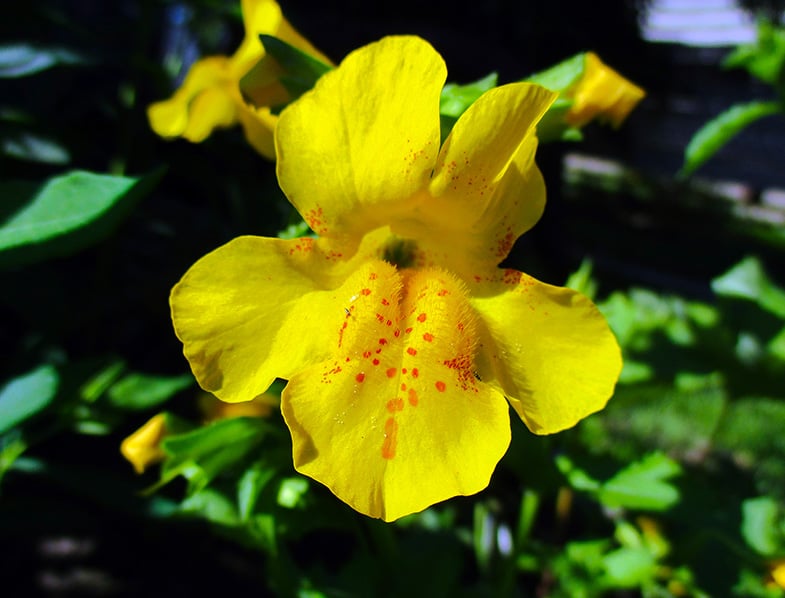
Mimulus Features: An overview
- Mimulus plants reach a top height of 45 cm and a top spread of 90 cm.
- Most Mimulus species are evergreen. The leaves can be round or elliptical, with an average width of 1 cm and a top length of 7 cm. The leaves differ for each species. They can be shiny or sticky, featuring either light or dark shades of green. Some species feature downy leaves or leaves with tooth-edges.
- Leaves may be sticky, downy and tooth-edged, or shiny and dark. Many species are evergreen.
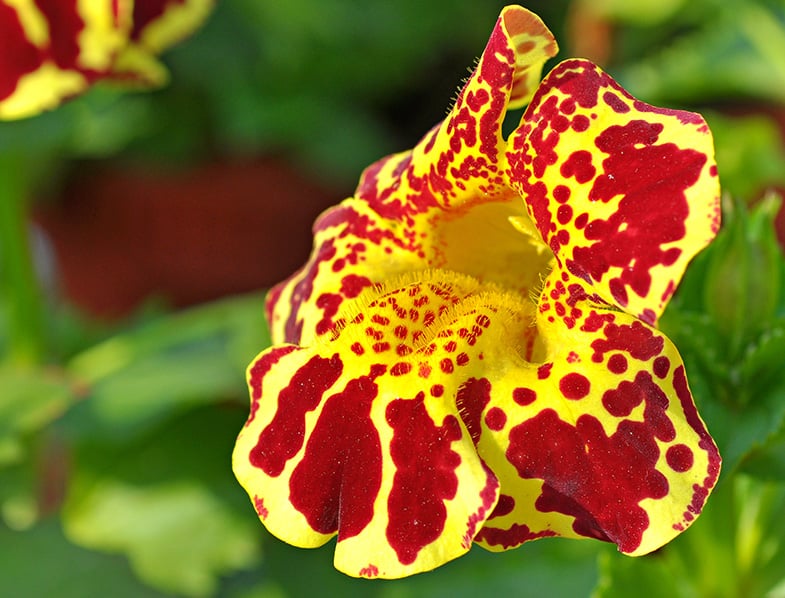
- The flamboyant Mimulus blooms come in many intense colours like yellow, orange, red, burgundy, purple, white, and even multicoloured. It blooms from late spring until late summer. In areas with mild autumns, you might even get the chance to enjoy some October blooms.
- The Mimulus bloom is tube-shaped at the base and it has a rather irregular trumpet shape. The flowers are about 3 cm wide and feature five lobes: three lower lobes and two upper lobes. The blooms appear on short stems, emerging from the upper leaf axils.
Growing Mimulus
Mimulus thrives in moist areas. It will be happiest on the margin of a stream, on a damp border, or on a soggy spot. As far as sun exposure goes, it can be very adaptable, provided that the soil humidity can balance the heat. It usually grows best in the shade, but it can also thrive in full sun if it is rooted in moist soil that doesn’t dry out. As a general rule, a partial shade placement will result in bushier foliage yet fewer blooms. On the other hand, a sunnier exposure will cause more blooms and fewer leaves.
Mimulus can also be grown as an aquatic plant. You should only plant it in shallow water once it reaches maturity. Seedlings and young plants are more sensitive and they might drown if planted directly in water. Keep in mind that the plants that grow in shallow water can get invasive at times.
Whether you plant it in the water or in the soil, it is recommended to deadhead it before it starts seeding. As far as overwintering goes, you don’t need to worry too much about the Mimulus. Most species are hardy to at least -20°C. You can help them go through winter by applying some much.

- [NUMBER OF SEEDS] - The waterproof package of seeds includes 700 seeds
- [FUN AND LEARN] If you’re new to being a plant parent, we’re here to make it easier. Our garden experts can provide you with guidance for detailed care every step of the way with a detailed growing guide
- [ENJOY GROWN] Buy seeds that grow well in your growing area. Make sure to read seed descriptions and buy seeds that work well in your gardening zone. If you live in a hot climate, get seeds that do well in hot climates
- [FUN IN YOUR GARDEN] If you're planning on creating a large, magnificent garden, learning how to grow your own plants from seed will save you plenty of money in the long run
- [FUN WITH KID'S SMILES] Planting seeds is our favorite kid's gardening activity. They are fascinated by how the seeds are tucked into the soil and they take great care by watering them daily, waiting for them to grow. When the first sign of green pops through the soil, the biggest smiles erupt from their faces. What a valuable life lesson!


- This low growing annual flowering mix only grows 8 - 10 inches wide and tall
- These low growing plants tolerate light frost and can be planted directly outdoors.
- An ideal bedding plant for shady conditions. Trumpet-shaped blooms in mix of blotched flame colors.
- Nice addition to color bowls, hanging baskets, or pond edge
- Sow 2 - 3 seeds per plant and space 8 - 10 inches apart

- NAME: Twinkle Orange Monkey Flower; SCIENTIFIC NAME: Mimulus Hybridus Twinkle Orange
- COLOR: Orange
- PLANT SEEDS: Outdoors after frost / Indoors weeks before last frost
- BLOOM TIME: Early Summer - Fall
- HARDINESS ZONE: N/A (but reseeds itself easily, so it acts like a perennial in all zones)
Last update on 2024-10-05 / Affiliate links / Images from Amazon Product Advertising API
Planting Mimulus
If you don’t have a stream in your garden, you will need to find another way to provide Mimulus with the moist soil that it needs to thrive. Seeds should be planted on the soil surface, whereas roots should be buried until the base of the stem.
To create an ideal growing environment for Mimulus, enrich your garden soil with humus, clay, or loam. Overall, the soil should be poorly drained. In terms of pH, the plant can adapt to all soils, be they alkaline, acidic, or neutral.
Watering Mimulus
This plant enjoys water with a neutral pH of 5.6 – 7.5. If you plant it on the edge of a stream or a pond, you won’t have to worry about watering it. If you plant it in a container or in a garden that doesn’t have a nearby water source, you will have to make sure that the soil is kept moist at all times.
Watering frequency will depend on the size of the container and the soil’s draining capacity. It is best to check the soil regularly until you understand how long it takes for it to dry. This way, you can set up a watering schedule that prevents the drying of the soil.
Propagating
Mimulus plants can be propagated through seeds, division, or softwood cuttings.
To propagate from seeds, you will have to sow the seeds in early spring. If you are a beginner gardener use a seed starter kit. You can also use an egg carton or a carton seed tray. Nonetheless, without a proper cover, it will be harder to maintain an adequate humidity level.
Whatever way you choose, sprinkle the seeds and lightly cover them with soil. The seedlings should appear in 8-10 weeks. You can transplant them outdoors once the danger of the last frost has passed. The good thing about carton seed containers is that you can cut the individual containers, and plant them outdoors. You don’t need to remove the seedlings from their individual carton containers.
To propagate Mimulus through division you will have to dig the plants out. Mature plants will have roots of younger plants attached to them. Use sharp tools to detach the young plants. Use carbendazim liquid to repair the damage to the roots after the division. Ideally, you should plant the young plants in a container, to allow them to recover and grow strong after the division. When they are well established, plant them outdoors preferably in late spring or early summer.
Last but not least, you can also propagate these plants through softwood cuttings. This procedure should also be done in late spring or early summer. Take 5 cm long cuttings from tender new seasonal growth. You should cut the plant below the leaf joint. Remove the lower leaves, dip the base of the cutting in rooting hormone and plant it in compost. When the cuttings are rooted harden them for two weeks before moving them outdoors.
In Conclusion
As you can see, Mimulus is an adaptable, hardy plant that can add a great deal of charm to your garden. As long as you keep its soil moist and expose it to a decent amount of sunlight, this plant will reward you with a gorgeous display of blooms all summer long.
You don’t have to be a skilled gardener to care for this plant. If you have a pond or a stream passing through your garden, Mimulus is surely the best plant to beautify that water feature. Not only will it be visually pleasing, but the Monkeyflower will surely surprise all your guests with its unique appearance.
Are you growing Mimulus? Share your experience in the comments.

1 Comment
I am growing the monkey flower in a pot. I just purchased from the nursery and repotted them in a larger pot, but am noticing the new blooms are dying before the actually flower.